The Biggest Lesson From Bermuda’s Largest Cyberattack Has Nothing to Do With Ransomware
TL;DR
- A cybersecurity assessment rated the Government’s risk as “critical” four months before the September 2023 attack. The warning existed before the attackers arrived.
- The attack succeeded in the gap between knowing about a critical weakness and fully fixing it. That gap, not ransomware, is the real lesson.
- The attacker was inside Government systems for roughly ten days before detection, with access to backups removed during that window.
- Around $4.4 million in cyber incident spending was referred to the Public Accounts Committee. The committee did not conclude this was a ransom payment.
- The same gap exists in private organisations that have an assessment on file and known findings still unaddressed.
- The practical question for every executive: are we currently living in the gap between knowing our weaknesses and fixing them?
When most people think about Bermuda’s September 2023 cyberattack, they think about ransomware. They think about hackers. They think about the possibility that millions of dollars may have been spent responding to the incident.
Those are fair questions. But after reading the Joint Select Committee’s report, we came away with a different conclusion.
The biggest lesson has almost nothing to do with ransomware. It has everything to do with what happened before the attackers ever launched their attack.
Months before Government systems went offline, a cybersecurity assessment had already warned that the risk was critical. The warning existed. The attackers did not surprise the assessment. The attack succeeded during the gap between knowing the problem and fully fixing it.
That may be the single most important cybersecurity lesson every Bermuda organisation can take from 2023.
The Timeline Everyone Should Understand
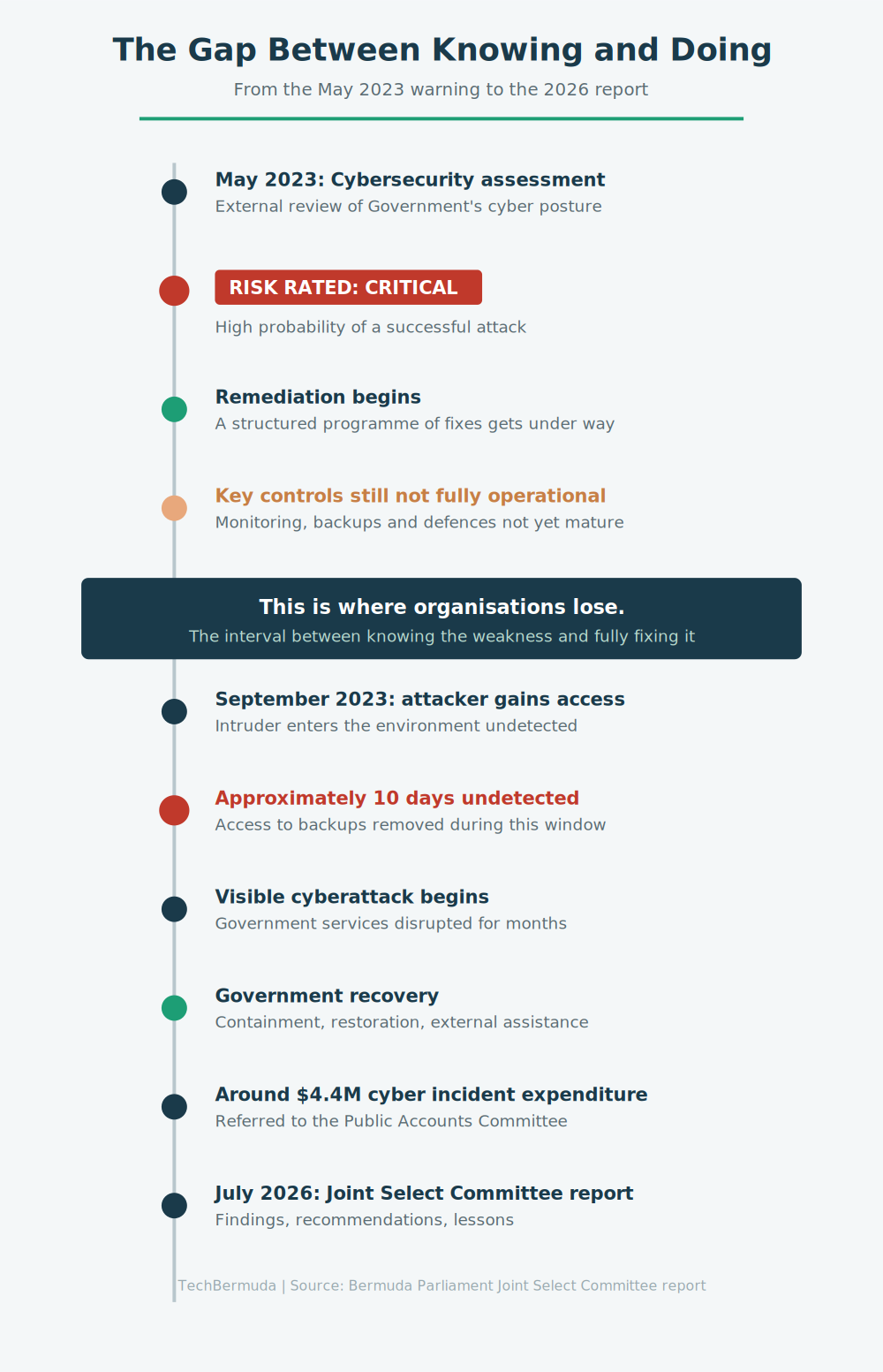
Long before Government systems went offline, the conditions that made the attack possible had already been identified. The warning existed. The work to reduce the risk had begun, but key protections were still incomplete when the attackers struck
The real lesson
This timeline is not unique to Government. Every organisation eventually finds itself somewhere on it. The important question is not “could we be attacked?” It is “are we currently living in the gap between knowing our weaknesses and fixing them?” That is where ransomware usually wins.
Here is what the public record and the committee’s report establish. In May 2023, a cybersecurity assessment by the firm Cyberdine rated the Government’s risk posture as “critical,” identifying a high probability of a successful attack and limited recovery capability. A remediation programme had begun, but as the committee puts it, key controls were “incomplete or not fully operational” when the attack occurred.
On the evening of 20 September 2023, systems entered the visible phase of the attack. Government-confirmed evidence, cited in the report, showed the attacker had been present in the environment for roughly ten days before that, with access to backups removed during the window. Services were disrupted for months. Budget figures record approximately $4.41 million in cyber incident expenditure, which the committee referred to the Public Accounts Committee to determine who was paid and why.
On the ransom question, TechBermuda follows the committee’s own caution. As first reported by The Royal Gazette, the report does not conclude that this money was a ransom payment. It says the scale, timing and description of the spending require full explanation. We treat it the same way. The lesson of this article lies elsewhere.
Why It Matters for Bermuda
It would be easy to read this as a Government story. It is not. It is a Bermuda story, and the parallels to the private sector are direct. The gap between knowing and doing is industry-agnostic.
Insurance and reinsurance. The island’s defining sector trades on a reputation for operational and regulatory resilience. A significant cyber incident is a signal to international counterparties about whether the jurisdiction can be trusted with their risk. The committee’s own recommendation for a National Cybersecurity Advisory Council drawing on ABIR and ABIC is an acknowledgement that cyber resilience here is a shared commercial asset.
Banks and financial services. Payments and banking infrastructure are critical to daily confidence. A known but unremediated weakness in a financial institution is the same gap the Government fell into, with regulatory consequences attached.
Healthcare. Health systems hold the most sensitive personal data on the island. The committee heard evidence from the Bermuda Hospitals Board as a benchmark for what mature monitoring looks like.
Law and professional services. Firms holding confidential client and transactional data are high-value targets, and often carry lighter internal security than their clients assume.
Small and mid-sized business. With limited IT resources, these organisations are the most likely to have a known issue sitting unaddressed for budget reasons. That is precisely the gap that was exploited.
IT Perspective
The technical heart of this report is the ten-day dwell time, and it deserves a moment. The committee, drawing on evidence from critical-infrastructure stakeholders such as Belco and the Bermuda Hospitals Board, notes that in a mature monitored environment, high-risk activity involving unusual access patterns, lateral movement, privilege escalation or attempted backup interference would generally be expected to generate alerts within hours or days, not go unseen for over a week.
That is the capability gap in a sentence. It is not about buying a single product. It is about having security monitoring, alert triage, endpoint visibility, privileged-access controls and tested escalation working together, so that an intruder moving quietly through the environment trips something before they are ready to strike. For most Bermuda organisations, a 24/7 in-house security team is unrealistic, and a managed detection and response service with strong internal oversight is the pragmatic route to the same outcome.
One point worth making calmly: the report frames its findings as cross-administration and non-partisan, concluding that Bermuda’s 2023 risk position accumulated over years as digital dependency outpaced security maturity. That is the right frame for the private sector too. This is a structural problem the whole island grew into.
Questions Every Executive Should Ask This Week
You do not need to be technical to ask these. They are governance questions, and the answers tell you whether your organisation is living in the gap.
- When was our last cybersecurity assessment, and what did it rate our risk?
- Have all the critical findings actually been remediated, or just acknowledged?
- How quickly would we detect an attacker already inside our systems?
- Are our backups immutable, and separate from the systems they protect?
- Have we ever tested a full restore, or do we only assume it works?
- Have we practised our incident response before a real crisis?
- Who, by name, owns cyber risk in this organisation?
- Does the board or leadership team actually receive cyber risk reports?
Could This Happen to Your Organisation?
A one-minute self-assessment. Answer honestly.
| Question | Yes | No |
|---|---|---|
| Have you completed a cybersecurity assessment in the last 12 months? | ☐ | ☐ |
| Have all critical findings been remediated? | ☐ | ☐ |
| Do you know how long an attacker could remain undetected in your environment? | ☐ | ☐ |
| Are your backups immutable and regularly tested? | ☐ | ☐ |
| Has your executive team discussed ransomware before a crisis occurs? | ☐ | ☐ |
| Have you conducted a tabletop exercise within the past year? | ☐ | ☐ |
| Is someone accountable for tracking remediation to completion? | ☐ | ☐ |
If you answered “No” to more than two of these, the most valuable lesson from Bermuda’s largest cyberattack is not what happened in 2023. It is what your organisation chooses to do next.
Take this with you. Download the printable
Cyber Resilience Self-Assessment (PDF)
to share with your team or bring to your next leadership meeting.
Capabilities That Close the Gap
Rather than name products that date quickly, focus on the capabilities. Any credible vendor in each category will do.
Detection. Endpoint detection and response gives you the visibility and behavioural alerting that shortens dwell time. This is the direct answer to the ten-day problem.
Backup and recovery. Look specifically for immutable or offline copies, separate from your main environment, and test your restores on a schedule.
Managed detection and response. For organisations without a 24/7 security team, an MDR provider delivers continuous monitoring and escalation as a service. Evaluate on response times, local support and reporting.
Governance frameworks. The CIS Critical Security Controls and the NIST Cybersecurity Framework both provide a structured baseline that maps closely to the minimum controls the committee recommends.
The Bottom Line
The Bermuda cyberattack should not only be remembered as a Government incident. It should become the moment every Bermuda organisation stopped treating cybersecurity as an IT project and started treating it as business resilience.
There is a great deal to unpack in the committee’s report, from the ten-day detection gap to the economics of recovery and the governance failures behind both. We will explore those lessons in future articles.